Competitive strategy: the difference between growth and expensive guesswork
Jun 19, 2026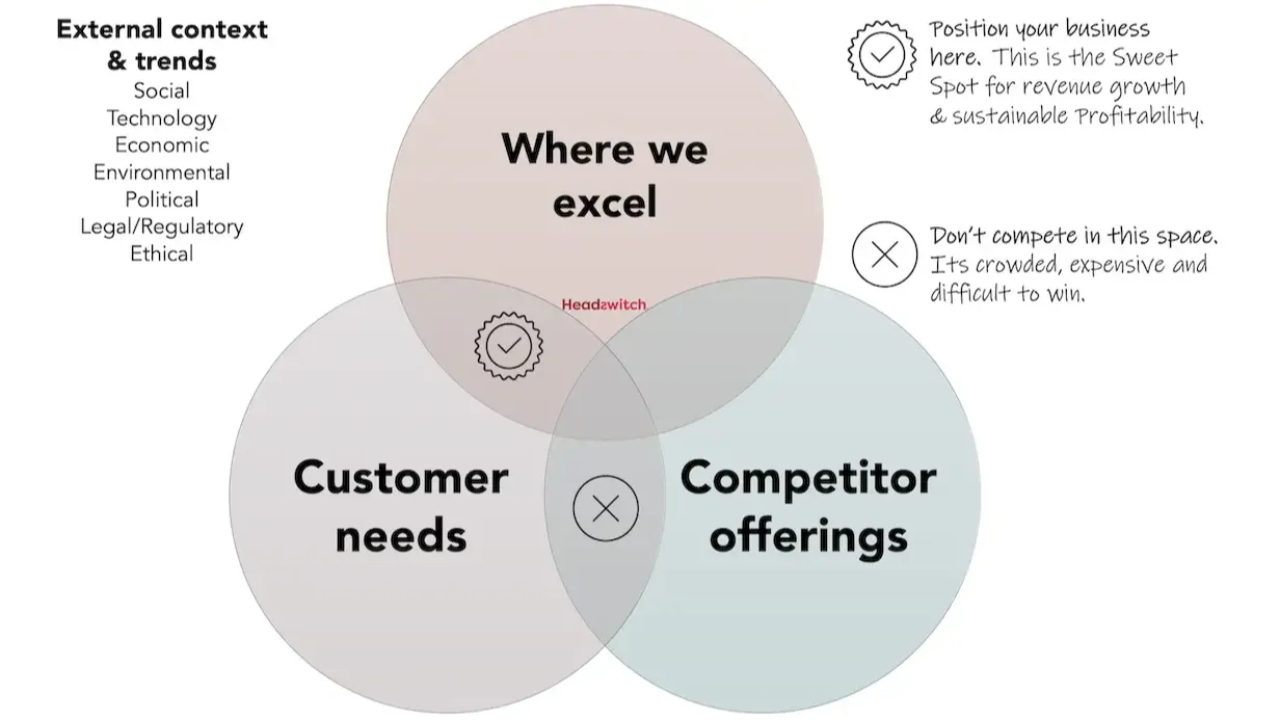
Author: Leanne Knowles
Read time: 5 minutes
Don't try to compete head on with the bigger players. Do this instead.
Every year, the statistics are published showing how many startups and small businesses are closed down. But that’s just the tip of the iceberg.
There are many more businesses that are limping along for years, barely making ends meet, struggling with inconsistent cash flow, networking their hearts out, and getting burnt out.
They struggle because they get lost in the crowd, trying to compete head on with bigger, established competitors, or lagging behind newer, faster, and focused startups with an edge.
They have no clear point of difference, no message that cuts through, no narrow focused niche audience to connect with in clear, less cluttered space.
They may even have be offering the wrong product or service to the wrong people for the wrong reason. The buyers just don't get it. Meanwhile the founder is tipping good money down the drain marketing something that doesn't have hungry buyers.
That is where competitive strategy earns its keep.
Competitive strategy helps you answer two brutal but useful questions:
- What will we do?
- What will we not do?
Simple questions. Big consequences.
Because without those answers, your business becomes a pinball machine. New offer? Ping. New platform? Ping. New competitor move? Ping. New customer request? Ping.
Before long, you are busy, tired, reactive and wondering why the business is not getting easier to grow.
What you’ll learn in this article
This article breaks down how competitive strategy helps you build a stronger, sharper business.
You will learn:
- What competitive strategy actually means.
- Why strategy creates simplicity.
- The four core parts of business strategy.
- The risks of not having a clear strategy.
- How to use strategy to guide better decisions.
What competitive strategy means
Competitive strategy is the clear plan for how your business will win in the market.
Not in theory. In the real world.
It defines where you will compete, who you will serve, what value you will deliver, and how you will do it differently or better than the alternatives.
A strong competitive strategy is not just a goal. A goal might be “grow revenue by 30%.”
That is useful, but it is not enough.
Strategy explains how you will grow revenue, who you will grow it with, what offers will lead the growth, what you will stop doing, and what kind of business you are actually building.
In plain terms, strategy is a set of decisions.
It is deciding what you will do, what you will not do, and how those choices will help you create a profitable outcome.
Why a clear competitive strategy is vital
Business can be loud.
There are trends, tools, tactics, customer demands, competitor moves, team issues, cashflow pressures and bright ideas flying at you from every direction.
Without strategy, every idea can look like a good idea.
That is the trap.
The traditional approach is to see a good idea and rush to implement it. A new product. A new lead magnet. A new service package. A new social media tactic. A new piece of software.
Some of those things may work.
But if they are not tied to one clear direction, they create confusion instead of growth.
That is how businesses become cluttered. The owner is working hard, the team is busy, the customer message is messy, and no one is quite sure what matters most.
Strategy gives the business a spine.
It creates one clear direction for decisions, resources, people, money, offers, marketing and delivery.
That is why strategy creates simplicity.
Strategy creates simplicity
A clear strategy helps you choose the right work, not just more work.
It gives you one big direction that guides the business.
This matters because customers do not buy confusion. They buy clear value.
When your business strategy is sharp, your message becomes easier to understand. Your offers become easier to explain. Your team knows what to focus on. Your time is spent on work that actually moves the business forward.
Strategy helps you do this:
- Choose better opportunities.
- Focus your time and money.
- Build offers customers understand.
- Make faster decisions.
- Align your people, systems and processes.
- Protect your energy from pointless busywork.
Strategy also helps you avoid this:
- Chasing every shiny idea.
- Copying competitors without thinking.
- Creating offers that do not connect.
- Burning cash on scattered marketing.
- Building a business that depends too much on you.
- Mistaking motion for momentum.
And yes, that last one stings a bit. But it is usually the one doing the most damage.
The four core parts of business strategy
A strong business strategy needs more than a clever line on a planning document.
It needs four working parts that connect thinking to action.
1. Goals
Your goals define the outcome you are working towards.
Good goals are clear, useful and motivating. They give the business a direction worth committing to.
Weak goals are vague. They sound nice but do not change decisions.
“Grow the business” is not enough.
A stronger goal might be to build a profitable service business that earns recurring revenue, reduces founder delivery time, and creates a better customer experience.
Now you have something useful to work with.
2. Focus
Focus is where strategy gets serious.
You cannot build a strong business by trying to be everything to everyone. When you choose what you will do, you also choose what you will not do.
That means trade-offs.
You may decide not to serve every customer type. You may decide not to offer custom work. You may decide not to compete on price. You may decide not to launch another service until your core offer is working properly.
That is not restriction. That is power.
Focus gives your business sharper edges. And sharp edges are easier for customers to notice.
3. Value
Value is the promise your business makes and the result your customer receives.
- The business makes a promise.
- The customer accepts the promise.
- The business delivers on the promise.
Then trust grows, revenue grows, referrals grow, and the business becomes easier to sell.
But when the value is unclear, everything gets harder.
Customers hesitate. Marketing feels forced. Sales calls drag on. Delivery becomes messy. Pricing becomes uncomfortable.
A strong competitive strategy makes your value obvious.
It answers:
- Who do we help?
- What problem do we solve?
- Why does it matter?
- Why should they choose us?
- What result do we deliver?
- How do we prove it?
That is the heart of a business that can compete without begging for attention.
4. Action
Strategy must turn into action, or it is just business theatre. Every major activity in the business should move it closer to the goal.
That includes your product or service offers, content, sales process, customer experience, team structure, systems, pricing, partnerships and delivery model.
If the action does not support the strategy, it is either a distraction or a cost.
Harsh? Maybe.
Useful? Absolutely.
The point of strategy is not to create a pretty plan. The point is to guide behaviour.
Your people, systems, processes and decisions must all pull in the same direction.
The risks of not having a competitive strategy
When competitive strategy is missing, the business does not usually fall apart overnight.
It drifts.
That drift can be expensive.
Here are the common risks.
1. You become reactive
Without strategy, you respond to whatever feels urgent.
A competitor drops their price, so you panic. A customer asks for something outside your model, so you say yes. A new trend appears, so you chase it.
This is how business owners lose control of the business they were trying to build.
2. Your message becomes unclear
If you are not clear on your strategy, your customers will not be clear on why they should buy from you.
You may sound like everyone else. Or worse, you may sound like three different businesses at once.
A confused buyer does not lean in. They leave.
3. You waste time and money
Scattered action is expensive.
You can burn money on marketing, tech, staff, content, consultants and new offers without fixing the real problem.
The issue is not always the tactic. Sometimes the tactic is fine, but it is being used inside a business with no clear direction.
That is like putting premium fuel in a car with no steering wheel. Bold move. Still going nowhere useful.
4. You attract the wrong customers
When your strategy is vague, your business often attracts people who are not the best fit.
They may want the cheapest option, the fastest fix, or endless customisation.
That creates pressure on pricing, delivery and founder energy.
A strong competitive strategy helps you attract the right customers because it makes your promise, position and value clearer.
5.You build a business that depends too much on you
Without strategy, owners often keep solving every problem manually.
They become the sales engine, delivery engine, decision-maker and quality control system.
That might work for a while.
But it does not scale well.
A clear strategy helps you design the business properly, so people, systems and processes can support growth.
6. You confuse growth with more work
Not all growth is good growth.
More customers, more offers and more revenue can still create a weaker business if the model is messy.
Competitive strategy helps you grow in the right direction.
That means stronger profit, better delivery, clearer positioning, and more freedom for the founder.
How to use competitive strategy in a small business
You do not need a giant corporate strategy document.
You need clear decisions.
The 7 strategy questions that matter most
Start with these questions:
- What outcome are we building towards?: This keeps the business focused on the end goal, not random activity.
- Who are we best placed to serve?: This sharpens your market, message, offers and customer experience.
- What problem do we solve better than the alternatives?: This defines your competitive edge and why customers should choose you.
- What do customers value most?: This helps you build offers people actually want, not just what you feel like selling.
- What will we be known for?: This gives the brand a clear position in the market.
- What offers, systems and people need to line up behind the strategy?: This connects the strategy to how the business actually makes money and delivers.
- What will we stop doing so we can focus on what matters now?: This cuts distractions, protects capacity and forces real choices.
This is where the rubber hits the road.
A good strategy should change what you do next week. Not just what you say in a planning session.
Competitive strategy gives your business a sharper future
Competitive strategy is not about sounding clever.
It is about making better decisions before your time, money and energy disappear into the business fog.
It helps you build a business with direction, not just activity.
It helps you choose your customers, shape your offers, protect your focus, and create value people actually want.
Most importantly, it helps you stop building by accident.
Because when you know what you will do, and what you will not do, the business becomes cleaner, stronger and easier to grow.
That is the real power of strategy.
It turns scattered effort into deliberate progress.
Get the inside edge
Want cutting-edge strategies and step-by-step guidance to build a business that practically runs itself —paying you while you sleep? Get the inside edge now.
And don’t worry, your info stays safe. No spam, no inappropriate sharing, just game-changing insights.
We hate SPAM. We will never sell your information, for any reason.