The sales sweet spot: Why your marketing needs this before you post, pitch or pay for ads
Jun 30, 2026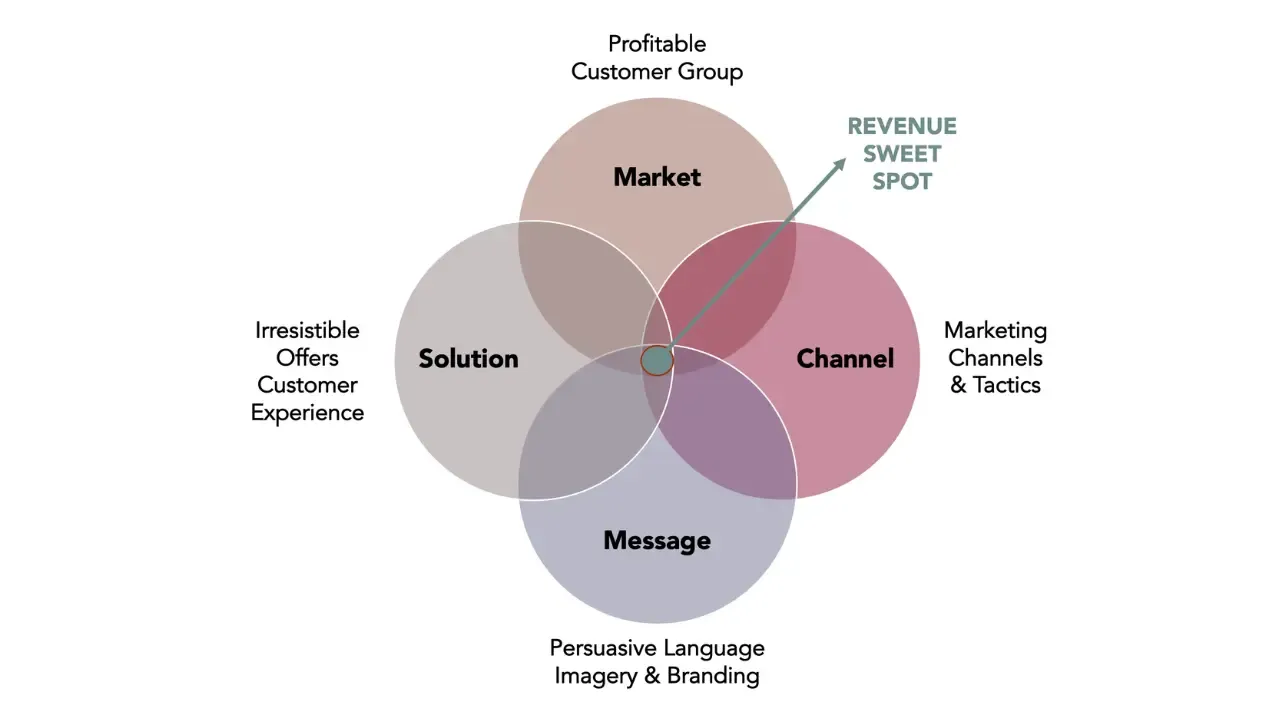
Author: Leanne Knowles
Read time: 5 minutes
It's not uncommon for a small business owner to blow $100,000 a year in marketing spend for $0 return.
These campaigns do not fail because the business owner is doesn't know marketing. They fail because the campaign is built on guesswork. Even the agencies are guessing sometimes.
The founder and their team posts on social media, runs ads, turns up to networking events, updates the website, sends emails, and then wonders why the response is flat.
The problem is clearly not effort or commitment. The problem is misalignment.
That is where the sales sweet spot comes in.
The are four key pieces that need to work together before a campaign has a strong chance of making money:
- Market
- Solution
- Message
- Channel
Where those four overlap, you find the revenue sweet spot. That is the place where the right people, the right offer, the right message and the right marketing channel lineup.
And when they do, your sales campaign stops feeling like shouting into the void with hope and a prayer.
What the sales sweet spot means
The sales sweet spot is the point where your campaign makes sense to the buyer and makes money for the business.
It is not just about being visible. Plenty of broke businesses are visible. It is about being visible to the right people, with an offer they actually want, using words that make them care, in a place where they are already paying attention.
That is the power of this model.
It forces you to stop asking, “What should I post today?” and start asking, “What campaign are we building, who is it for, and why would they act now?”
That is a much smarter question.
1. Market: The profitable customer group
The element element is market.
This is about knowing who you are best placed to serve. Sorry, but everyone with a pulse and a wallet, is not a market. That is a panic attack in business clothing.
A strong campaign starts with a clear customer group that has:
- A real problem.
- A reason to solve it.
- The ability to pay.
- A desire for your kind of solution.
- A reason to choose you over the alternatives.
This matters because your market shapes everything else.
A campaign for a busy allied health clinic owner will sound different from a campaign for a new creative freelancer.
A campaign for a funded tech founder will sound different from a campaign for a local service business owner.
When the market is clear, the message gets sharper. The offer gets stronger. The channel choice gets easier.
When the market is vague, everything downstream gets messy.
2. Solution: The irresistible offer and customer experience
The second element is solution.
This is what you are selling and how the buyer experiences it. A strong solution is not just a list of services. It is a clear answer to a meaningful problem.
It should help the buyer understand:
- What result they can expect.
- What problem it solves.
- Why it matters now.
- What makes it different.
- What happens after they buy.
- This is where many campaigns fall apart.
The business has skills, experience and good intentions, but the offer is too loose. It sounds like “I can help with lots of things,” which usually makes the buyer think, “Great, but what exactly am I buying?”
An irresistible offer gives the buyer a clear path.
It turns your hidden brilliance into something they can understand, trust and act on.
The customer experience matters too. If the offer looks good but the buying process is confusing, clunky or slow, the campaign leaks trust before the sale even happens.
3. Message: The persuasive language, imagery and branding
The third circle is message.
This is how you communicate the value of your solution to the market.
Your message includes your words, visuals, brand cues, examples, proof, stories and calls to action.
A strong message helps the buyer feel seen.
It says, “We understand the problem you are dealing with, and we know how to help you solve it.”
That is very different from generic marketing that says, “We are passionate about helping businesses thrive.”
Lovely. Also wallpaper.
Good messaging should make the buyer think:
- That is exactly what I am dealing with.
- That is the result I want.
- That sounds practical.
- That feels trustworthy.
- That is different from what I have already tried.
The message is where strategy becomes human.
It turns your offer into language people can connect with.
4. Channel: The marketing channels and tactics
The fourth circle is channel.
This is where your campaign shows up.
It could be social media, paid ads, email, SEO, webinars, events, networking, partnerships, referrals or direct outreach.
But here is the trap. Most business owners start with the channel.
They ask, “Should I be on Instagram?” or “Should I run Facebook ads?” or “Should I go to more networking events?”
That is backwards.
The better question is, “Where does my best customer already pay attention, build trust and make buying decisions?”
The channel should match the market, solution and message.
A high-trust service may need education, proof, referrals and relationship-building before someone buys. A lower-cost digital product may work well through content, email and ads. A B2B advisory offer may need LinkedIn, strategic partnerships and direct conversations.
The channel is not the strategy. The channel carries the strategy. Big difference.
Why the overlap matters
The overlap is where the money is.
When all four pieces line up, the campaign feels clear, relevant and useful.
- The market knows the offer is for them.
- The solution solves a problem they care about.
- The message makes the value obvious.
- The channel reaches them in the right place at the right time.
That is when sales and marketing become a system, not a guessing game.
It is not magic. It is alignment.
And alignment is where campaigns get their power.
Skipping this work is expensive.
Not always in one big dramatic crash. Sometimes it is death by a thousand tiny marketing tasks.
You post content that gets attention from the wrong people.
- You run paid ads before the offer is clear.
- You network with people who are never going to buy or refer.
- You write vague captions that sound nice but do not move anyone.
- You change tactics every few weeks because nothing seems to be working.
- You blame the platform when the real issue is the strategy.
That is the brutal bit.
If the market, solution, message and channel are not lined up, more activity just creates more noise.
Paid ads make this even more obvious. Ads do not fix a weak offer or unclear message. They just put it in front of more people faster.
That can be useful if you are testing properly.
It can be painful if you are just throwing money at confusion and hoping the algorithm has a business degree.
Why this matters before social media posting
Social media works best when it is part of a campaign, not a daily scramble for content.
Before posting, you need to know:
- Who the post is for.
- What problem it speaks to.
- What belief it needs to shift.
- What offer it supports.
- What action you want the reader to take.
- Without that, social media becomes a treadmill.
Lots of movement. Not much progress.
The sales sweet spot gives your content a job.
Some posts can build trust. Some can educate. Some can show proof. Some can sell. But they should all point back to the same strategic centre.
Why this matters before paid ads
Paid ads need sharp thinking before budget.
A paid campaign needs clear answers before the money starts moving:
- Who is the buyer?
- What are they already looking for?
- What problem are they trying to solve?
- What offer are we testing?
- What message are we testing?
- What landing page or sales process comes next?
If these pieces are missing, the ads are not the problem.
The campaign is undercooked.
Good ads amplify clear strategy. Bad ads expose weak strategy. Either way, the bill arrives.
Why this matters before networking
Networking is also a campaign.
It just wears nicer shoes.
If you do not know your sales sweet spot, you will struggle to explain what you do in a way people remember, understand or refer.
You may end up saying too much, pitching too early, or sounding like every other service provider in the room.
When your sweet spot is clear, you can explain:
- Who you help.
- What problem you solve.
- Why it matters.
- What makes your approach different.
- Who would be a good referral.
That makes networking more useful because people can actually place you in their mind.
And if they can place you, they can refer you.
How to use the sales sweet spot in your next campaign
Use the four circles as a campaign planning tool before you create anything.
Ask these questions before you post, pitch, launch or spend:
- Market: Who is the profitable customer group this campaign is built for?
- Solution: What offer or experience solves their problem in a clear and valuable way?
- Message: What words, proof, stories and visuals will help them understand and trust the offer?
- Channel: Where should this campaign show up so the right people see it and act?
- Centre: Where do all four pieces overlap in a way that can drive revenue?
That final question matters most.
You are not looking for random marketing ideas. You are looking for the campaign idea that has the best chance of turning attention into action.
The real power of the sales sweet spot
The sales sweet spot gives your marketing a backbone.
• It helps you stop chasing tactics and start building campaigns with intent.
• It makes your offer easier to understand.
• It makes your content sharper.
• It makes your ads smarter.
• It makes your networking more useful.
• It makes your sales process feel less forced because the buyer can see the value sooner.
For a small business owner, this is not just marketing theory.
It is a practical way to protect your time, money and energy, because the goal is not to be everywhere. The goal is to be in the right place, with the right message, for the right people, selling the right solution.
That is where the money starts to make sense.
That is the sales sweet spot.
More articles about growing your business by increasing revenue and maintaining strong profit:
- Brand before marketing or get lost in the crowd
- Smart pricing for service pros: earn more without the stress
- How to get a freedom business
- If your business was easy to start, here’s how to avoid getting stuck
- 5 ways to grow small business profit like a pro
About your author

Leanne Knowles knows her stuff when it comes to ditching the hustle and building a business that runs without you. Formerly stuck and stretched in her small business, Leanne developed a simple system to bottle your brilliance, and build a thriving, scalable business that can run without you.
🔗 Connect with Leanne on LinkedIn
Get the inside edge
Want cutting-edge strategies and step-by-step guidance to build a business that practically runs itself —paying you while you sleep? Get the inside edge now.
And don’t worry, your info stays safe. No spam, no inappropriate sharing, just game-changing insights.
We hate SPAM. We will never sell your information, for any reason.