The most important decisions for business growth and founder freedom
Jun 10, 2026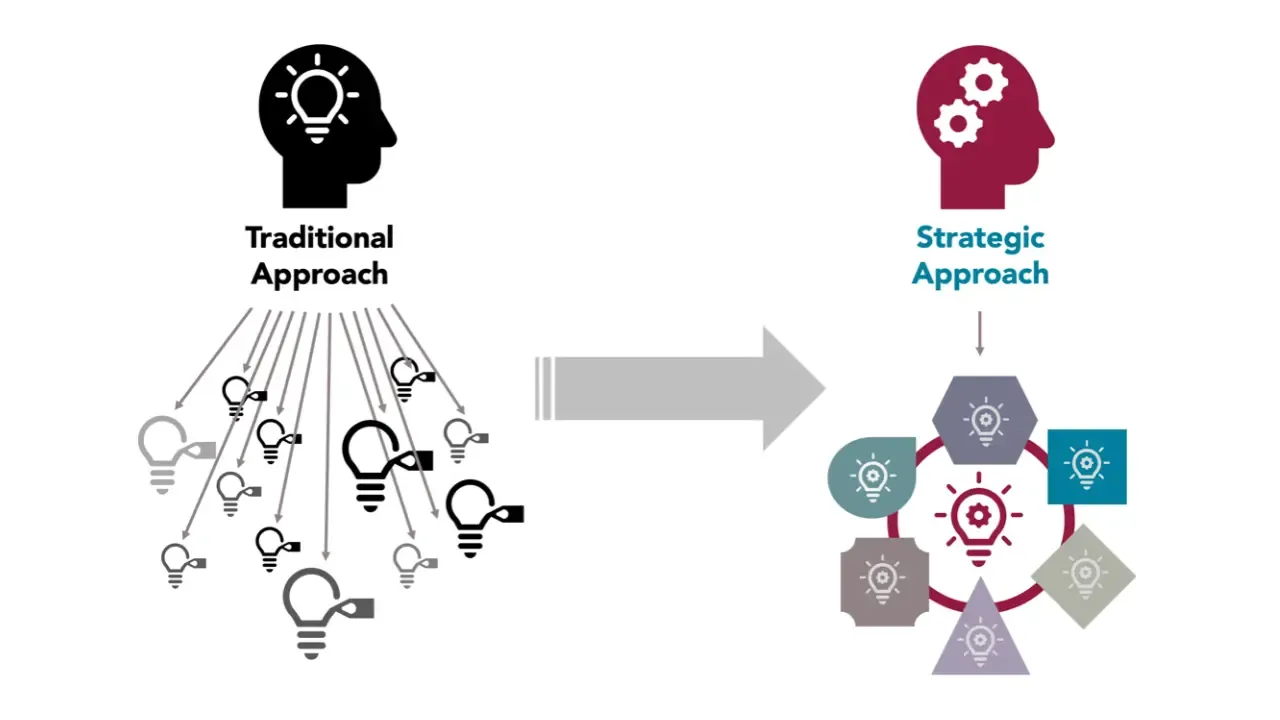
Author: Leanne Knowles
Read: 3-4 minutes
When you need to fix something, the answer is here
Strategy is the set of choices that guides your business. You decide what you will do and also what you will not do in order to achieve your goals. Strategy helps you to focus your attention and resources, and avoid taking random detours that pull you in different directions.
A strategy cascade is the chain of decisions that turns your big business direction into practical action. It shows how each layer of your business strategy flows into the next part, so your business is not built from random choices.
If you need to change something for growth, profitability, scalability, founder freedom, or because something isn't working, you'll find it here.
Here’s what you’ll learn in this article
This article explains the main parts of a strategy cascade in plain English.
- What the strategy cascade is
- Why strategy comes before marketing, sales and delivery
- What each key business term means
- How each part connects to the next
- How to use the cascade to find gaps in your business
Your strategy cascade answers a set of questions that drive your goals:
- Where are we going?
- How will we win the competitive for customers?
- What will we sell?
- How will we make money?
- How will we reach customers?
- How will we deliver the value?
- How will the whole business keep improving?
The point of a strategy cascade is alignment.
Your business strategy should shape your product strategy. Your product strategy should shape your profit model. Your profit model should shape your business model, revenue model, revenue streams, go-to-market model, distribution model, delivery model and revenue system.
When the cascade is clear, every part of the business has a job.
Strategy helps you avoid chasing every opportunity, saying yes to the wrong work, presenting and offer that nobody understands, undercharging, wasting time on random marketing, and creating a business that depends too much on you.
A strategy cascade helps you build the business in the right order, so the parts work together instead of pulling against each other.
Your business strategies that work together
Here's 12 strategies that each requires purposeful decisions.
- Business – the ultimate definition
- Business strategy – Why you exist and how you win
- Product strategy – The solution to your buyer’s problem
- Profit model – How you make enough money to keep
- Business model – The formula that delivers value
- Revenue model – How you get paid
- Revenue streams – The flow of money
- Go-to-market (marketing) model – Who you’re selling to and how
- Distribution model – How they receive the offer
- Delivery model - How your offer gets into your customer’s hands
- Operating model - How the business is structured to run and scale
- Revenue system – The engine that connects, sells, delivers and improves it all
Each strategy decision explained in more detail
1. Business
A business is the whole thing you are building.
It starts with the customer you serve, the problem you solve, the value you create, the money you make, and the way the business runs.
A business is not just your skill, idea, service, logo or website. Those things matter, but they are not the whole business. A real business exists only while you have paying customers who are active and satisfied.
The practical question is: What are we building, who is it for, and why does it deserve to exist?
2. Business strategy
Business strategy explains why your business exists and how it will win customer in a competitive market.
This is where you choose your direction. You decide who you will serve, what problem you will solve, where you will focus, and what makes your business different.
This matters because most small business owners are not short on effort. They are short on focus.
Without business strategy, you can spend your time reacting to whatever lands in front of you. You chase random ideas. You copy competitors. You serve too many types of customers. You build offers that do not fit together.
A clear business strategy helps you make stronger decisions.
The practical question is: Where will we focus, and how will we win with the right customers?
3. Product strategy
Product strategy explains the solution you create for your buyer’s problem.
For a service business, your product may be a service package, workshop, program, membership, audit, roadmap, online course, digital product or advisory offer.
This is where your knowledge becomes something people can understand, trust and buy.
A strong product strategy makes the problem clear. It makes the promise clear. It makes the pathway clear. It also helps you package your hidden brilliance in a way that is easier to sell and deliver.
The practical question is: What are we selling, what problem does it solve, and why would someone choose it?
4. Profit model
The profit model explains how your business makes enough money to stay healthy.
Revenue is the money coming in. Profit is what is left after the real costs are paid.
This includes delivery time, labour, software, admin, marketing, overheads, tax, support and founder pay.
Many service businesses struggle because the offer looks profitable on the surface, but takes too much time, energy or labour to deliver.
A strong profit model helps you see whether the business can actually work, not just whether people will buy.
The practical question is: Can this business make enough profit after all costs are paid?
5. Business model
The business model explains the operating formula that delivers value.
It shows how your business creates value for customers and captures value for itself.
This includes your target customer group, products and services, sales and marketing channels delivery method, resources, partners, costs and revenue logic.
Two businesses can sell the same skill but use very different business models.
For example, a consultant could sell private consulting, group coaching, a membership, a digital program, a licence, or a certification model.
The knowledge may be similar, but the structure changes everything.
The practical question is: How does this business create value, deliver value and get paid for that value?
6. Revenue model
The revenue model explains how you get paid.
This is the payment structure behind the business.
Customers might pay once, monthly, yearly, by project, by retainer, by licence, by subscription, by usage, or by results.
Your revenue model affects cash flow, risk and growth.
A project model can bring in good money, but it can also create gaps between sales. A recurring model can create more stable income, but it needs strong ongoing value.
The practical question is: What is the best way for customers to pay for the value we provide?
7. Revenue streams
Revenue streams are the different flows of money into the business.
Your revenue model explains how you get paid. Your revenue streams show where the money comes from.
A service business might have several revenue streams, such as:
- A core service package
- A recurring support offer
- A digital product
- A paid workshop
- A diagnostic or audit
- A licence or white-label offer
Revenue streams matter because relying on one source of income can be risky.
If one stream slows down, the whole business feels it. Strong revenue streams give the business more options, more stability and more room to grow.
The practical question is: What are the main ways this business earns money?
8. Go-to-market model
The go-to-market model explains who you are selling to and how you will reach them.
This is your plan for taking the offer into the market.
It includes your best-fit buyer, message, channel, sales process, proof, and the steps people take before they buy.
A strong go-to-market model helps buyers find you, understand you, trust you and take action.
Without it, even a strong offer can sit there doing very little.
The practical question is: Who needs this offer, where are they, and how will we help them buy?
9. Distribution model
The distribution model explains how customers access or receive the offer.
For a digital offer, this might be your website, Kajabi, email, a checkout page, a download page, a client portal or a partner platform.
For a service, this might be a booking system, onboarding process, physical location, referral channel, online platform or partner network.
Distribution matters because a strong offer can still lose sales if the buying or access process is confusing.
The easier it is for customers to find, buy and receive the offer, the stronger the business becomes.
The practical question is: How will customers find, access and receive what they bought?
10. Delivery model
The delivery model explains how your offer gets into your customer’s hands and creates the promised result.
This is about how the value is delivered.
It might be one-to-one, group, do it yourself, done with you, done for you, digital, automated, in person, online or hybrid.
For service businesses, this is one of the most important growth decisions.
If delivery depends too much on the founder’s time, growth will be limited. If delivery is clear, repeatable and supported by systems, the business has more room to grow.
The practical question is: How will we deliver the result in a way that is clear, repeatable and sustainable?
11. Operating model
The operating model explains how the business is set up to run behind the scenes.
Your delivery model explains how customers get the result. Your operating model explains how the business makes that happen smoothly.
It covers who does the work, what systems are used, what can be automated or delegated, how decisions are made, and how quality is managed.
For service businesses, this matters because growth often adds more admin, more delivery pressure and more decisions. Without a clear operating model, the founder becomes the backup plan for everything.
A strong operating model helps the business grow without everything depending on the founder.
The practical question is: How does the business need to be structured, staffed and systemised so it can run without relying on the founder for every decision, task and problem?
12. Revenue system
The revenue system is the engine that connects, sells, delivers and improves it all.
It brings the full strategy cascade together.
Your revenue system connects your offer, marketing, sales, delivery, customer experience, repeat business and improvement process.
It is not just about making one sale. It is about building a business that can keep attracting the right buyers, selling the right offer, delivering the result and improving over time.
A strong revenue system helps the business grow with more structure and less guesswork.
The practical question is:
How do all the parts work together to bring in revenue, deliver value and improve the business?
How to use the strategy cascade
For a startup founder and very small business, the decisions about each strategy level are simple and easily recorded in strategy document. Pause and ask these questions up front, so you are making decisions on purpose.
For an established business owner, the strategy cascade is useful because it helps you find the weak link in your business.
These are the decisions that can free you from the business and unleash profitable, scalable growth at a level you never thought possible.
Use this as a simple checklist to find the weak spots in your business model. The goal is not to tick every box perfectly. The goal is to see what needs your attention first.
Ask yourself:
- Business: Is it clear what we are building, who it is for, what problem it solves, and why the business has a strong reason to exist?
- Business strategy: Have we chosen where we will focus, who we will serve, and how we will win with the right customers?
- Product strategy: Is our offer clear, useful, easy to understand, and built around a problem people are willing to pay to solve?
- Profit model: Can this business make enough profit after delivery costs, wages, tools, marketing, overheads and founder pay are covered?
- Business model: Does the way we create, deliver and capture value actually support growth, not just more work?
- Revenue model: Is the way customers pay us stable, suitable and strong enough to support healthy cash flow?
- Revenue streams: Do we have the right mix of income streams, so the business is not relying on one offer, one client type or one sales method?
- Go-to-market model: Do we know exactly who we are trying to reach, what message they need to hear, and how we will help them buy?
- Distribution model
Is it easy for customers to find, access, buy and receive what we sell? - Delivery model: Can we deliver the promised result in a clear, repeatable and sustainable way without draining the founder?
- Operating model: Can the business run smoothly without every task, decision, question and problem coming back to the founder?
- Revenue system: Do our offer, marketing, sales, delivery, customer experience and improvement process work together as one connected system?
Quick scoring option
Score each question from 1 to 5.
1 = unclear or not working
3 = partly working, but needs improvement
5 = clear, strong and working well
The lowest score shows the next part of the business to fix. That is usually where the growth leak is hiding, or where you are getting stuck in the operations.
You don’t need to fix everything at once. Start with the part that is causing the most pressure. That is usually where the next smart move is.
Conclusion
Strategy matters because it turns effort into direction.
Without it, you can work hard and still build a fragile business. You can attract the wrong customers, create offers that are hard to sell, undercharge, overdeliver, and become trapped in your own delivery model.
The strategy cascade helps you see the business as a full system.
Your business strategy shapes your product strategy. Your product strategy shapes your profit model. Your profit model shapes your business model. Your business model shapes your revenue model, revenue streams, go-to-market model, distribution model, delivery model and revenue system.
When these parts work together, the business becomes easier to understand, easier to sell, easier to deliver and easier to improve.
That is the real job of strategy.
It helps you build the right business, for the right people, in the right way.
More articles about growing your business with strategic clarity and intent:
- Purposeful business design; build a business that pays you back
- How to get more customers with a brand that actually stands out
- The perils of tactics without strategy that you need to consider
About your author

Leanne Knowles knows her stuff when it comes to ditching the hustle and building a business that runs without you. Formerly stuck and stretched in her small business, now the freedom strategist for founders who are over the grind and ready to scale like a boss, with systems, not burnout.
Get the inside edge
Want cutting-edge strategies and step-by-step guidance to build a business that practically runs itself —paying you while you sleep? Get the inside edge now.
And don’t worry, your info stays safe. No spam, no inappropriate sharing, just game-changing insights.
We hate SPAM. We will never sell your information, for any reason.